What is the difference between customer and supplier ledgers?
Customer ledgers show what customers owe the company, while supplier ledgers show what the company owes its suppliers.
Genoa keeps both, and includes ageing for each.
Customer and supplier ledgers in Genoa show what each customer owes the company and what the company owes each supplier. Genoa includes ageing for both customers and suppliers, which shows how long each balance has been outstanding. Ageing helps a company follow up old debts and plan its payments to suppliers.
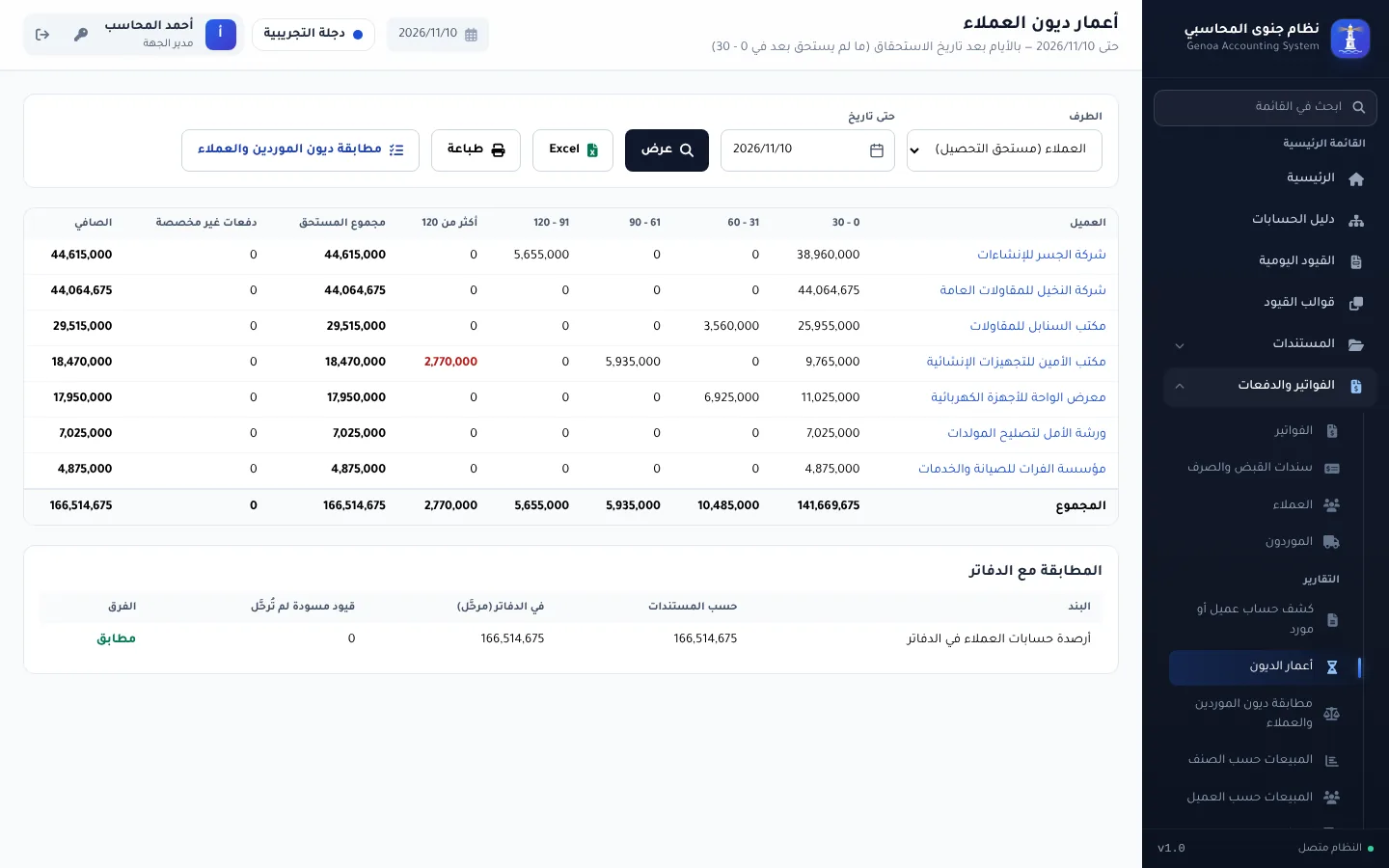
Customer balances are amounts customers owe the company, usually from sales on credit. Supplier balances are amounts the company owes its suppliers, usually from purchases on credit.
Buying and selling on credit is common in the Iraqi market, so a company needs to know exactly where it stands with each customer and each supplier.
Ageing shows how long each balance has been outstanding. A debt that is a week old is a different matter from one that has been open for months.
Customer ageing shows which debts have been outstanding longest and need following up. Supplier ageing shows which amounts owed are oldest, so payments can be planned.
Customer and supplier ledgers are part of the same product as sales and purchasing and accounting. A sales invoice on credit is reflected in the customer's ledger, and a purchase invoice on credit in the supplier's ledger.
This keeps the ledgers consistent with what has been recorded in sales, purchasing and the accounts.
It is common for Iraqi companies to deal with customers or suppliers in US dollars. For these cases, Genoa offers multi-currency: the invoice is priced in dollars at an exchange rate, and the balance is recorded in the books at its Iraqi dinar equivalent.
Multi-currency is optional: it is off by default and switched on per organisation, according to each company's needs.
Customer ledgers show what customers owe the company, while supplier ledgers show what the company owes its suppliers.
Genoa keeps both, and includes ageing for each.
Yes. Ageing in Genoa covers both customer and supplier balances.
Customer ageing helps with collections, and supplier ageing helps with planning payments.
Record what the company sells to customers and buys from suppliers, alongside stock and the ledgers.
Keep the books in Iraqi dinars in the same product as inventory, sales and purchasing, and the ledgers.
Work in US dollars alongside Iraqi dinars. Optional, off by default and switched on per organisation.
Book a demo and we will walk you through the screens that matter to you, or send us your question on WhatsApp.