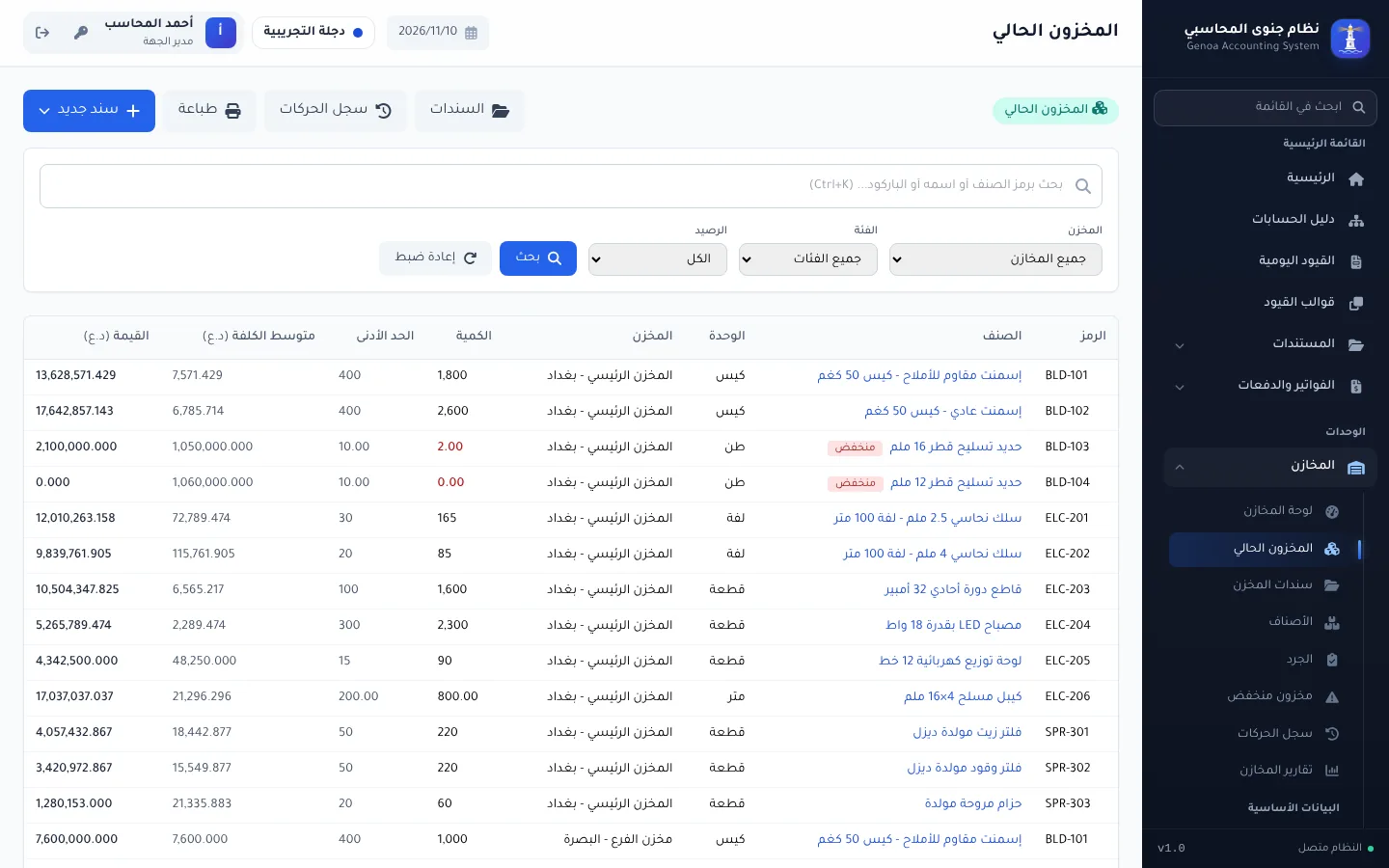
Why does a trading company need to track its stock?
In a trading company, stock is cash sitting on shelves. Knowing what is in stock and what it cost helps the company buy at the right time and avoid running out or overstocking.
Without a clear system, stock figures become guesswork, and it is hard to know the real profit on each item.
How is inventory linked to purchasing and sales in Genoa?
Inventory, sales and purchasing are modules of the same product. Purchases bring items into stock, and sales take them out.
Because accounting is part of the same product, stock movements are also reflected in the accounts.
What is the cost of an item in stock?
An item's cost is what the company paid to buy it. Imported goods, however, usually carry extra charges such as freight, transport and customs duties.
For this, Genoa offers landed cost, which adds freight and customs on top of item cost. It is an optional feature: off by default and switched on per organisation, according to each company's needs.
What should you ask about inventory in a demo?
Bring a short list of your items and a recent purchase invoice to the demo, and ask questions like these:
- How are items set up in Genoa?
- How do I see the quantity on hand for a given item?
- How is item cost worked out when the purchase price changes from one shipment to the next?
- Does our company need the landed cost feature?
Questions about inventory
Do I need landed cost to use inventory in Genoa?
No. Inventory is a core module of Genoa and works without the landed cost feature.
Landed cost is optional, off by default and switched on per organisation. It is useful for companies that pay freight and customs on imported goods.
Is inventory separate from accounting in Genoa?
No. Inventory and accounting are modules of the same product, not two separate programs.
Stock movements from sales and purchases are reflected in the accounts, so the same transaction does not need to be entered twice.
All frequently asked questions: Genoa